Post Impressionism
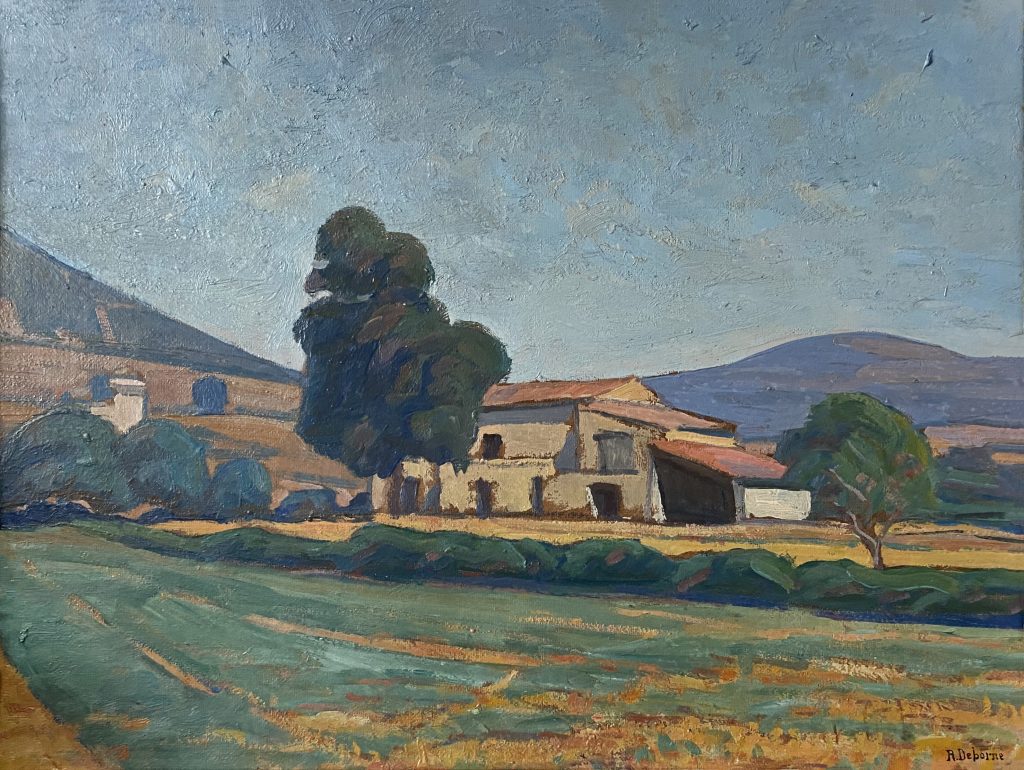
The 1870s was a critical decade for Western art, with the emergence of the revolutionary Impressionist art movement. Born in 1870, there is no doubt that this radical new movement would have influenced Deborne during his studies at art school. The Impressionist movement sought to represent the real world, rather than scenes of classical subjects, and emphasised the use of light and colour to define moments in time. With the new invention of ready-mixed paint in tubes came the shift towards plein air painting, enabling artists to more readily capture scenes of life and nature as they happened. The notion of plein air painting to capture ‘impressions ’ of daily life was clearly important to Deborne: his oeuvre consists almost entirely of landscapes painted at varying times of day, utilising colour and light to depict the sun’s rays.
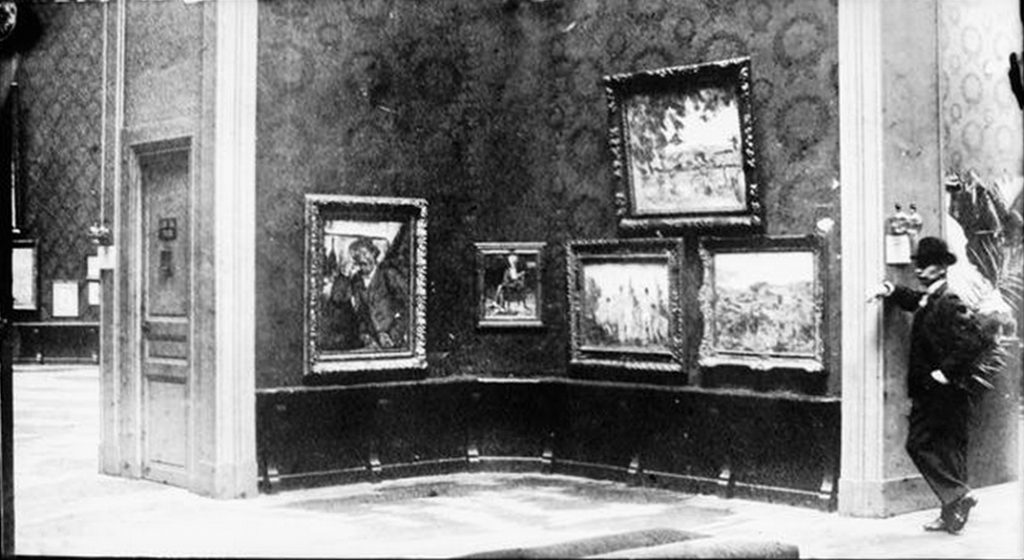
The novelty of Impressionism was divisive, drawing criticism from academicians who thought the movement went too far and from artists who thought it did not go far enough. Amongst this latter group emerged what has come to be known as the Post-Impressionist phase, which was more of a response to the perceived restraints of Impressionism as opposed to its own consolidated movement. The Post-Impressionists also sought to depict reality, but with less naturalistic colour and light – instead, they prioritised the symbolic content and structure of an image, using colour as an independent bearer of emotional and aesthetic significance. Deborne’s works are more in line with Post-Impressionist tendencies, utilising thick brushstrokes, non-naturalistic colours, and block-like compositions.
Unsurprisingly, both of these movements – and their many offshoots – were denigrated by the Paris Salons. Even the Salon des Refusés – the exhibition of works rejected from the Salon – demonstrated bias against the Post Impressionist artists, prompting the creation of a new Salon-style exhibition space that would celebrate, not spurn, this new turn in French art. In 1884, the Société des Artistes Indépendants was formed with the sole intention of accepting the artworks of all who wished to take part. The debut show exhibited works by Redon, Signac, Seurit, Gauguin and van Gogh, amongst many other household Impressionist names. Concerns soon began to emerge about the juryless approach taken by the Société des Artistes Indépendants. Whilst admirable, it had led to the display of works of varying quality. In an attempt to create a new Salon that was still far from the bureaucracy of the Salon whilst maintaining certain standards for the quality of a displayed artwork, Belgian architect and author Frantz Jourdain founded the Salon d’Automne. Their first show took place in 1903, supported by Renoir and Rodin, and featured works from Matisse, Lebasque, Vuillard and Guillaumin.
This Salon proved critical for Deborne in particular. The 1905 Salon d’Automne has become infamous for its launch of the Fauvist movement. The Fauves – French for ‘ wild beasts ’ – estranged themselves from realistic use of colour, instead favouring unnatural and vibrant colours in their compositions. This undoubtedly influenced Deborne, whose strong and blocky palette is very akin to the Fauvist aesthetic. It is not entirely Fauvist, however, as there remains a semblance of realism with his palette, demonstrating the fluidity and overlapping qualities of these movements associated with Impressionism and Post-Impressionism. Despite this overlap and the fact that Fauvist and Post-Impressionist and Impressionist works were often all displayed together, they were not necessarily a cohesive movement and subscribed to differing aesthetic ideologies.
Without the Salon des Independants and the Salon d’Automne, Deborne would not have been able to flourish as a Post-Impressionist artist. There would have been no other exhibitions of this scale through which he could exhibit his art, and his repeated engagement with both of the Salons demonstrates that he was critically aware of his reliance on the new Salons for success. It is also revealing about Deborne himself, as his commitment to the Impressionist Salons demonstrates a deep antipathy he held towards the tight constraints of the Paris Salon. Rather than sacrificing his own artistic expression, Deborne chose to oppose the all encompassing, powerful institution of the Paris Salon by joining splinter Salons that had no guarantee of success.